IFSCA’s Order Against Estee IFSC: When the Parent Company Does the Real Work
An IFSC stockbroker’s trading was run from its parent’s office outside GIFT IFSC. The order explains why the licensed work must be done in IFSC, by the licensed entity.
Key takeaways
- The licensed work must be done in GIFT IFSC. The IFSC entity’s own people must do it. Having servers in GIFT City is not enough if the people doing the work sit outside.
- Support work can be outsourced, but core work cannot. For a stockbroker, core work means executing and monitoring trades. For an FME, the closest equivalent is investment decisions and dealing.
- Use your own outsourcing policy. It should be approved by the IFSC entity’s own board and actually followed. A copy of the parent’s policy does not count.
- A late fix does not cancel the breach. Corrective steps may reduce the penalty, as they did here, but the earlier non-compliance still counts.
- FMEs face the same expectations. Regulations 7(5), 10 and 123(2) of the IFSCA (Fund Management) Regulations, 2025 require the Principal Officer and key managerial personnel to be based in IFSC, adequate office space and manpower, and proper controls over outsourced work.
Many companies in GIFT IFSC are subsidiaries of Indian groups. The reason is simple. The parent company already has the traders, the systems and the compliance team, so it feels natural to let the parent handle the work while the IFSC company holds the licence.
A recent IFSCA order shows why this approach can go wrong. On October 21, 2026, IFSCA imposed a penalty on Estee IFSC Private Limited, a stockbroker registered in GIFT IFSC since January 2017. The company’s trading was being run by its parent’s staff from outside GIFT IFSC, and the company did not have its own outsourcing policy. The penalty was small, but the order explains clearly what IFSCA expects from every entity it regulates, including Fund Management Entities.
What IFSCA found
The matter started with surprise visits. On July 30, 2025, IFSCA officials went to the company’s GIFT IFSC office and found it closed. They came back on August 14, 2025. This time only the Compliance Officer was there. The Principal Officer was at the parent company’s office in the Domestic Tariff Area (DTA), which is the part of GIFT City outside the IFSC.
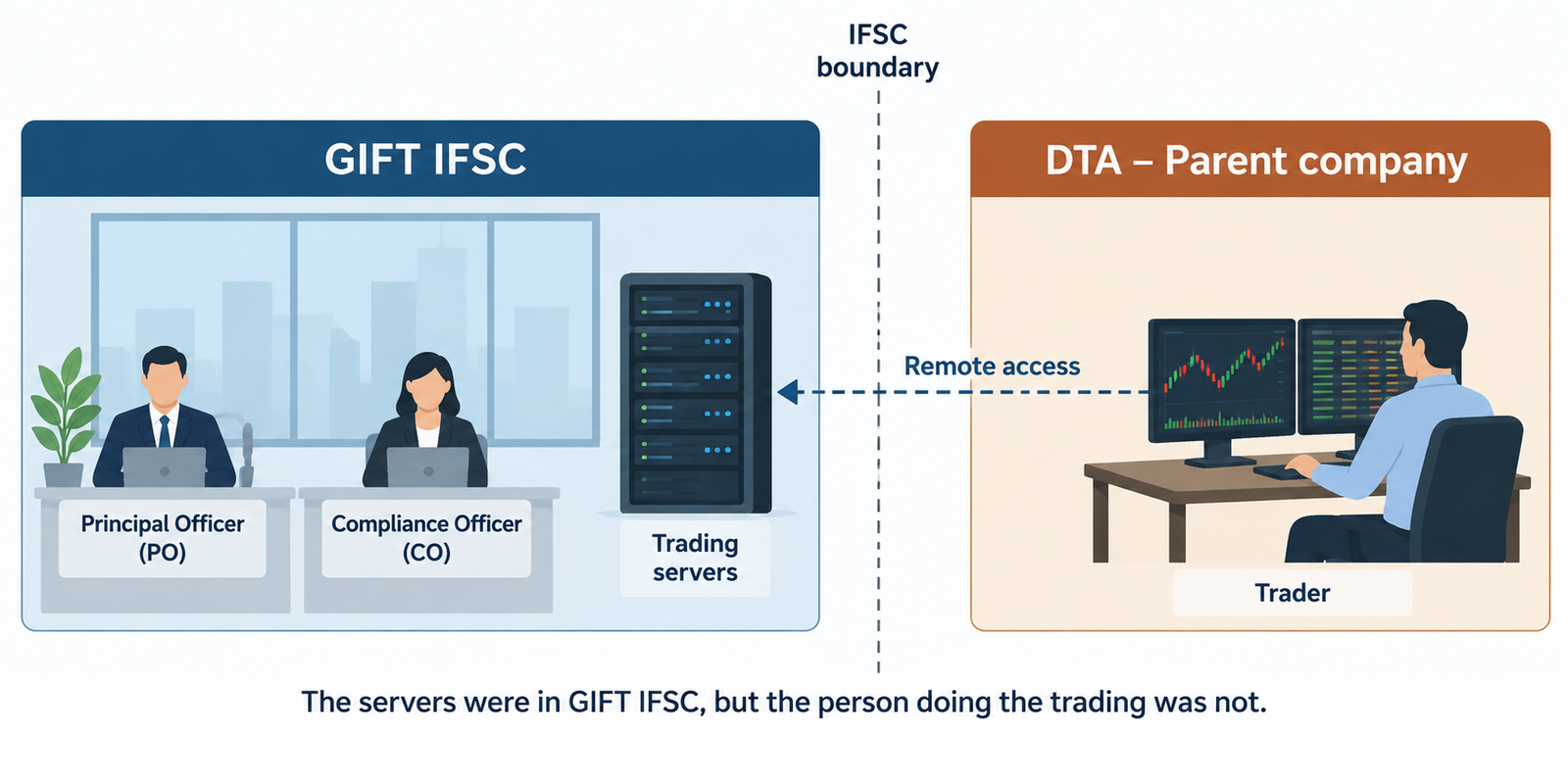
When the officials asked about trading, the Compliance Officer told them something important. The company’s trader was sitting in the DTA and accessing the GIFT IFSC exchanges through remote access software. In other words, the trading was not being done from the IFSC office at all.
IFSCA wrote to the company on August 27, 2025 and asked it to comply with the manpower rules. On October 7, 2025, officials visited again and collected documents. One of these was a 2017 agreement between the company and its parent, Estee Advisors Private Limited, for “investment advisory and technology support services”.
After reviewing the documents, IFSCA concluded that the company had handed over its core work to the parent. The parent was creating the algo trading strategies, executing the trades and monitoring them afterwards. On December 5, 2025, IFSCA issued a warning letter and asked the company to fix this by December 31, 2025.
The company did not fully meet that deadline. It appointed a dedicated analyst for its trading desk only from April 1, 2026, and informed IFSCA about this on March 25, 2026. It also adopted its own outsourcing policy around the same time and signed an addendum with the parent so that core activities would no longer be outsourced. IFSCA issued a show cause notice on June 25, 2026, held a hearing on August 24, 2026, and passed the final order on October 21, 2026.
The rules involved
The order relies on a few simple requirements.
The first is about people. Regulation 9(6) of the IFSCA (Capital Market Intermediaries) Regulations, 2025 says that an intermediary must have adequate manpower commensurate with its business activities in IFSC. Having a Principal Officer and a Compliance Officer on paper is not enough. The people who actually do the business must be there.
The second is about resources and procedures. The Code of Conduct under both the 2021 and 2025 CMI Regulations requires an intermediary to have, and effectively use, the resources and procedures needed to run its business properly.
The third is about outsourcing. Clause 18 of Part A of Schedule II to the 2025 Regulations allows an intermediary to outsource activities from outside IFSC, but only under its own internal outsourcing policy, and it must follow that policy at all times.
“A CMI shall have adequate manpower commensurate with its business activities in an IFSC.”
“A CMI shall have an internal policy for outsourcing of its activities from outside of IFSC and the CMI shall ensure compliance with the policy at all times.”
The IFSC entity must have enough of its own people in IFSC to run its business. It can take outside help, but only under its own outsourcing policy, and it must follow that policy every day, not just keep it on file.
IFSCA also referred to a 2011 SEBI circular on outsourcing. That circular says intermediaries cannot outsource their core business activities and compliance functions. For a stockbroker, it gives order execution and monitoring of trades as examples of core work. This was exactly the work Estee IFSC had given to its parent.
Support work such as IT, accounts or back-office processing can be outsourced under a proper policy. The core work of the licence cannot. For a stockbroker, that means executing and monitoring trades. The same SEBI circular treats investment-related work as core for portfolio managers and mutual funds.
The company’s defence
The company made several points in reply. It said that on July 30 the office had closed at around 4:45 PM after a walkthrough, and that the Principal Officer and Compliance Officer were present until then. It said that on August 14 the Principal Officer was busy with a SEBI inspection of the parent company. It pointed out that all its trading servers were co-located at the exchange in GIFT City. It also said it had only one active client, that it had now fixed everything, and that this was the first time such issues had been raised against it.
IFSCA was not convinced on the main issue. Co-locating the servers in GIFT City did not answer the real question, which was who was actually doing the work. The order notes that the company itself admitted that trade monitoring and support were being handled by the parent, and that it had been relying on the parent’s outsourcing policy instead of its own.
What IFSCA decided
The Quasi-Judicial Authority for Enforcement (QJAE) held that the company had not complied with the manpower and outsourcing rules from the date of its registration until March 25, 2026. That is a long period, and the failure continued even after a clear warning with a deadline.
The company had argued that it had already corrected the position. IFSCA accepted that corrective steps had been taken, but said they did not wipe out the earlier failure. In simple terms, fixing a problem after being caught does not undo the years when the problem existed.
“…although the Noticee has taken corrective actions to remedy the situation but the same does not absolve the Noticee from the continuous failure on its part to comply with the applicable regulatory requirements as well as the clear directions issued by the IFSCA in this regard.”
IFSCA imposed a penalty of ₹1,00,000 under Section 15HB of the SEBI Act, 1992. This is the minimum penalty under that section, which ranges from ₹1 lakh to ₹1 crore. While deciding the amount, IFSCA considered the nature of the violation, the company’s other compliances and the corrective action it had taken. The penalty must be paid within 45 days, in foreign currency at the RBI exchange rate on the date of the order. Late payment attracts simple interest at 12% per year.
The penalty is ₹1,00,000, but it must be paid in foreign currency at the RBI rate on the date of the order.
If the rate were ₹88 per US dollar (an assumed figure, for illustration only), the amount would be 1,00,000 ÷ 88 = about USD 1,136.
If the payment is 30 days late after the 45-day period, interest would be 1,00,000 × 12% × 30 ÷ 365 = ₹986.
Always check the actual RBI rate for the order date before paying.
The more serious part of the order is the direction. The company must now comply with the manpower and outsourcing rules at all times. If it fails again, IFSCA has said it may take stringent action, including suspension or cancellation of its registration. The company has the option to appeal to the Securities Appellate Tribunal.
Why this matters for Fund Management Entities
Estee IFSC is a stockbroker, so this order was passed under the CMI Regulations. But the same thinking applies to FMEs, and the FME Regulations have similar requirements.
Regulation 7(5) of the IFSCA (Fund Management) Regulations, 2025 requires the Principal Officer and other key managerial personnel to be based in IFSC. Regulation 10 requires an FME to have adequate office space, equipment, communication facilities and manpower, matching the size of its operations in IFSC, with a dedicated office. Regulation 123(2) requires proper internal controls, including over any activity that has been outsourced.
The SEBI circular that IFSCA relied on also lists “investment related activities” of portfolio managers and mutual funds as core work that cannot be outsourced. This order does not decide whether IFSCA would apply the same test to an FME. But the message is clear enough. If an FME’s investment decisions, dealing or risk work is actually being done by a sponsor team in Mumbai or elsewhere in India, the FME is open to the same kind of finding.
Ask one simple question: if IFSCA visits your GIFT IFSC office without notice on a normal working day, will it find the people who take investment decisions and monitor trades sitting there? If the honest answer is “they are usually in Mumbai”, the set-up needs to be fixed before the visit, not after it.
This is not the first time IFSCA has looked at this issue. It earlier issued a warning order to an FME, Neo Asset Management Private Limited (IFSC Branch), over the absence of its Principal Officer and key personnel during surprise visits.
A few practical lessons
For any IFSC entity that works closely with a parent company in India, the order points to some basic checks.
First, be clear about who is doing the licensed work. For an FME, that means who takes the investment decisions, who executes trades and who monitors them. These people should belong to the IFSC entity and should be working from GIFT IFSC.
Second, remember that IFSCA tests this through surprise visits. Employment letters are not enough if the office is empty on an ordinary working day.
Third, read your group agreements carefully. Estee’s problem was visible in an agreement signed in 2017, at the very start. Old intra-group agreements often show how the business really runs.
Fourth, have your own outsourcing policy, approved by your own board and actually followed. A copy of the parent’s policy will not do.
Finally, take every IFSCA letter seriously and meet its deadline. In this case, the company fixed things eventually, but it was too late to avoid a penalty.
Conclusion
The amount of the penalty in this case is small. The principle behind it is not. A GIFT IFSC registration is not just a licence that a parent company can operate from outside. IFSCA expects the regulated work to be done in IFSC, by the regulated entity, through its own people and its own policies. For FMEs that are part of larger Indian groups, now is a good time to check whether their set-up would hold up during a surprise visit.
You can read the full IFSCA order here: Order in the matter of Estee IFSC Private Limited dated October 21, 2026.
Frequently Asked Questions
Can an IFSC company take help from its parent company in India?
Yes, but only for support work, such as IT, accounts or back-office processing. This must be done under the IFSC company’s own outsourcing policy. Core work cannot be outsourced. For a stockbroker, that means executing and monitoring trades.
Is it enough if the trading servers are located in GIFT City?
No. In this case the servers were co-located at the exchange in GIFT City, but the trader was sitting in the parent’s office in the DTA. IFSCA looked at who was actually doing the work and where they were sitting.
Can an IFSC company use its parent company’s outsourcing policy?
No. The IFSCA (CMI) Regulations, 2025 require the IFSC entity to have its own internal outsourcing policy and to follow it at all times. Estee IFSC was relying on its parent’s policy, and IFSCA treated this as a breach.
Does fixing the problem before the hearing avoid a penalty?
Not always. Estee IFSC had fixed the gaps by the time of the hearing, but the breach had continued from its registration till March 2026, even after IFSCA’s warning letter. The fix helped keep the penalty low, but it did not cancel the breach.
Why was the penalty only ₹1 lakh?
₹1 lakh is the minimum penalty under Section 15HB of the SEBI Act, 1992. IFSCA considered the nature of the violation, the company’s other compliances and its corrective steps. The bigger risk for the company is IFSCA’s warning that a repeat could lead to suspension or cancellation of its registration.
Does this order apply to Fund Management Entities?
Not directly, because it was passed under the CMI Regulations. But the IFSCA (Fund Management) Regulations, 2025 have similar rules. Regulation 7(5) requires the Principal Officer and key managerial personnel to be based in IFSC. Regulation 10 requires adequate office space and manpower. Regulation 123(2) requires proper controls over outsourced work. FMEs should treat this order as a clear signal.
Can the company appeal against the order?
Yes. The order allows an appeal to the Securities Appellate Tribunal under Section 15T of the SEBI Act, 1992, read with Section 13(4) of the IFSCA Act, 2019.
By CS Prashant Kumar, Founder, FUNDREG