How an Investment Fund Works: Raising Money, Investing It, Returning It, and Paying the Manager
The life of a fund from investor commitment to final distribution, and the fee and carried-interest arrangements that pay the people who run it
Key takeaways
- Track three figures, not one. A closed-ended fund raises capital through commitments that the manager draws down over time, so committed capital, contributed capital and uncalled commitment must be tracked separately. In the IFSCA framework, a scheme’s corpus is measured by commitments, not by cash
- The offering document sets the rules. It fixes the strategy, tenure, fees and expenses. Under Regulation 128, an FME must disclose the maximum fees and each expense item separately. Under Regulation 36(2), a material change in a restricted scheme’s strategy needs two-thirds investor consent by value
- The waterfall decides who is paid first. Money returns to investors through distributions from exits and income. These are allocated by a waterfall that typically returns capital and a hurdle to investors before the manager earns carried interest.
- The manager earns in three ways. It is paid a management fee for running the fund and carried interest for generating profits. It must also invest its own money: in IFSC restricted schemes, through the FME or its associate under Regulation 40.
- Gross and net returns can differ sharply. In the worked example, a 2.5x gross result became a 1.8x net result for investors.
When an investor puts USD 250,000 into a venture capital fund, the money usually does not leave their account on the day they sign. They make a binding promise to pay when the manager asks. Over the following years, the manager draws on that promise, buys stakes in businesses, sells them and sends cash back. Along the way, the manager is paid twice: once for running the fund, and again for making money.
Every pooled fund follows this cycle, whether it is a scheme managed by a Fund Management Entity in GIFT IFSC or an Alternative Investment Fund registered with SEBI. Once you understand how money flows in, how it is put to work, how it flows out and how the manager is rewarded, the regulations stop reading like a list of rules and start reading like answers to obvious questions.
This article walks through that cycle from start to finish, using one hypothetical fund throughout.
Pooled money, a mandate and a professional manager
A fund is a pool of money contributed by several investors and managed by a professional under a pre-agreed set of rules. Those rules cover what the fund may invest in, how long it will run, how investors get their money back, and what the manager will be paid.
Three features distinguish a fund from an investor simply hiring an adviser.
The money is pooled. Each investor owns units or an interest in the pool, not shares in the underlying companies.
The investor gives up day-to-day control. Investment decisions belong to the manager, within the limits set by the fund documents.
The arrangement is regulated. Because the manager handles other people’s money, regulators require registration, disclosure, governance and reporting. In GIFT IFSC, the governing framework is the IFSCA (Fund Management) Regulations, 2025, under which the manager is registered as a Fund Management Entity (FME). For funds set up in India outside the IFSC, it is the SEBI (Alternative Investment Funds) Regulations, 2012.
Portfolio management services work differently. Under PMS, a client’s money is not pooled; each client has a separate portfolio held for that client. This article deals with pooled funds.
Who does what in a fund
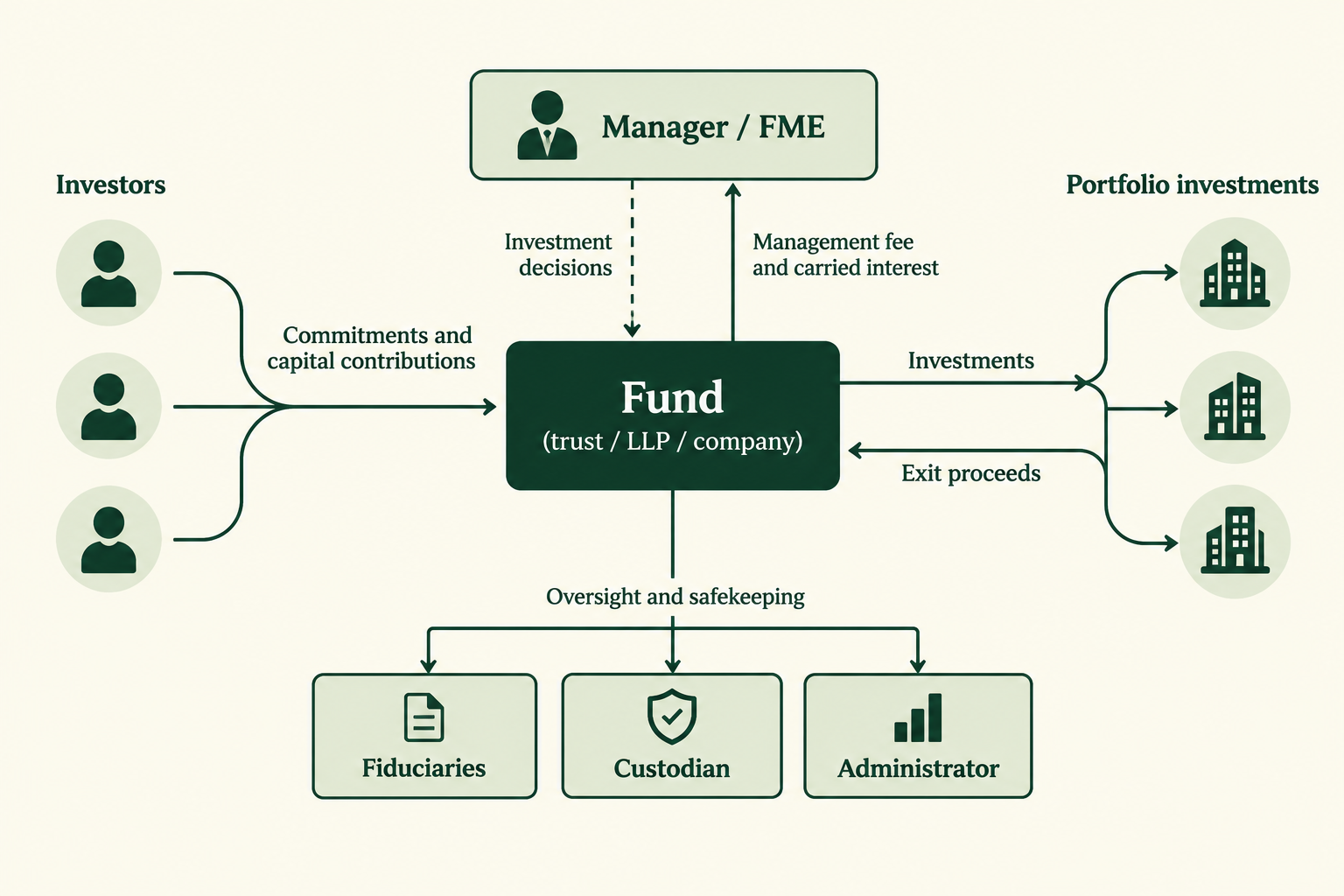
A beginner’s first difficulty is usually the number of parties involved. Each exists for a reason, and several exist mainly to keep the manager honest.
|
Participant |
Role in plain English |
Common labels |
|
Investors |
Provide the capital and receive the returns |
Limited partners (LPs), unitholders, contributors |
|
Manager |
Decides what to buy and sell and runs the fund day to day |
Investment manager, general partner (GP); FME in GIFT IFSC |
|
Sponsor |
Sets up the fund and commits its own money to it. A defined role under the SEBI AIF framework; for IFSC schemes, the equivalent obligation sits with the FME or its associate |
Sponsor, promoter |
|
Fiduciaries |
Oversee the fund on behalf of investors: the board, designated partners or trustees, depending on the fund’s legal form |
Trustee, board, designated partners |
|
Custodian |
Safekeeps the securities |
Custodian |
|
Fund administrator |
Keeps investor records, calculates NAV, processes capital calls and distributions |
Fund accountant, registrar and transfer agent |
|
Auditor |
Checks the fund’s accounts independently |
Statutory auditor |
The labels change with the legal form. A fund set up as a trust has trustees. One set up as an LLP has designated partners, and one set up as a company has a board.
Under the IFSCA framework, the FME must appoint these fiduciaries before it files a scheme document with the regulator (Regulation 17(2)). Each scheme’s annual accounts must be audited by an auditor who is not associated with the FME and who is appointed by the fiduciaries (Regulation 135).
Internationally, a fund is often a limited partnership. The investors are “limited partners” and the manager’s entity is the “general partner”. Indian and IFSC practice borrows this vocabulary even where the legal vehicle is a trust or a company.
Raising Capital: From Investor Commitments to the First Close
The Offering Document and the Terms of Investment
Before approaching investors, a fund manager needs to establish what the scheme will invest in, how it will operate and on what terms investors will participate.
The principal disclosure document depends on the regulatory framework under which the fund is established. Under the IFSCA framework, a privately placed scheme uses a placement memorandum, while a retail scheme uses an offer document. In the domestic Indian market, SEBI-regulated Alternative Investment Funds (AIFs) use a private placement memorandum (PPM).
These documents set out the investment objective and strategy, proposed corpus, tenure, risk factors, fees and expenses, and other terms relevant to an investor's decision. They also explain how the scheme will be managed and what investors can expect in relation to distributions, exits and other aspects of the fund's operation.
For a restricted scheme in GIFT IFSC, Regulation 36(1) specifies disclosures required in the placement memorandum, including:
- The investment objective and strategy.
- The proposed corpus and tenure.
- The proposed fees and expenses.
- Risk management practices.
- The FME's key managerial personnel.
The manager must also consider the restrictions on departing from the disclosed investment strategy. Under Regulation 36(2), a material deviation from the stated strategy requires the consent of at least two-thirds of investors by value of their investment, subject to the precise scope and conditions of the applicable provision.
The fund's contractual arrangements are documented separately. A contribution agreement sets out the terms on which an investor commits capital to the scheme, while the fund's constitutional document establishes its legal framework. Depending on the structure, that constitutional document may be a trust deed, an LLP agreement or the articles of a company, read with any other applicable constitutive documents.
The placement memorandum, contribution agreement and constitutional documents therefore serve different purposes. The placement memorandum explains the scheme to prospective investors; the contractual documents establish the rights and obligations governing their participation.Capital Commitments, Contributions and Uncalled Capital
In a closed-ended fund, an investor generally commits a specified amount but does not transfer the entire amount when signing the subscription documents. Instead, the investor makes a capital commitment and contributes the money when the fund manager issues a capital call in accordance with the fund documents.
This arrangement is common in venture capital, private equity and private credit funds, where investments are made over a period of time rather than on a single date.
The IFSCA framework recognises the distinction between committed capital and money already received. Regulation 2(1)(j) defines the scheme's corpus by reference to the total amount committed by investors under a written contract or similar document as on a particular date. Accordingly, the corpus is not simply the amount lying in the scheme's bank account.
Three figures are particularly useful when reviewing a fund's capital position:
|
Term |
Meaning |
|
Committed capital |
The total amount an investor has contractually agreed to contribute to the fund. |
|
Contributed or paid-in capital |
The amount the investor has actually transferred to the fund. |
|
Uncalled or undrawn commitment |
The portion of the commitment that has not yet been called, subject to the terms of the fund documents. |
Consider a fund in which an investor commits USD 500,000. The manager initially calls USD 100,000 to complete an investment. A few months later, another USD 75,000 is called to finance a second investment.
At that point, the investor has contributed USD 175,000 and has an uncalled commitment of USD 325,000, assuming there have been no other capital calls, distributions, reductions or adjustments.
The manager can call the remaining amount as further investments and other permitted funding requirements arise, subject to the commitment terms and the applicable fund documents. Those documents should specify how capital calls are made, the notice period available to investors and the consequences of failing to fund a valid call.
For investors, the arrangement avoids transferring the entire commitment before the fund needs the money. For the manager, it provides access to committed capital over the investment period without requiring the scheme to hold all the funds from the outset.
First Close, Subsequent Closes and Final Close
Fundraising does not necessarily end when the first investor signs the subscription documents. Many funds admit investors in stages, allowing the manager to begin operations while continuing to raise capital.
The first close is the point at which the fund admits its initial group of investors and satisfies the conditions necessary to proceed with its activities. The precise requirements for reaching that point depend on the fund documents and applicable regulatory requirements.
The manager may subsequently admit additional investors at one or more subsequent closes. The final close marks the end of the fund's commitment-raising period, subject to the terms governing the scheme.
Investors admitted after the first close may enter a fund that has already made investments or incurred expenses. The fund documents may therefore provide for an equalisation payment or another adjustment so that later investors participate on the agreed economic basis relative to earlier investors.
For example, if the fund has already called capital from its initial investors to complete an investment, an investor joining at a subsequent close may be required to contribute an amount calculated under the fund's equalisation provisions. Depending on those provisions, the adjustment may also account for specified expenses or an interest component.
The calculation is not necessarily identical across funds. The placement memorandum and contribution agreement should explain how subsequent closings are handled and how the resulting amounts are allocated between the scheme and its investors.
Minimum Investment and Corpus Requirements Under IFSCA and SEBI Regulations
Fundraising is subject to regulatory thresholds that vary according to the type of scheme and the regulatory regime governing it. These thresholds may apply to the amount invested by each investor, the overall size of the scheme and the number of investors who can participate.
The following table summarises the requirements stated in the draft. The figures and exceptions should be checked against the latest applicable regulations before publication.
|
Requirement |
IFSCA VC Scheme (Authorised FME) |
IFSCA Restricted Scheme (Registered FME) |
SEBI AIF (Domestic) |
|
Minimum investment per investor |
USD 250,000; USD 60,000 for employees, directors or designated partners of the FME; no minimum for accredited investors, as stated in Regulation 20(2) |
USD 150,000; USD 40,000 for employees, directors or designated partners of the FME; no minimum for accredited investors, as stated in Regulation 32(2) |
₹1 crore, with specified concessions for employees and directors of the manager and exemptions for accredited investors, subject to applicable conditions |
|
Minimum corpus |
USD 3 million, with a maximum of USD 200 million, as stated in Regulation 23(1) |
USD 3 million, as stated in Regulation 35(2) |
₹20 crore per scheme |
|
Maximum number of investors |
50, as stated in Regulation 20(1) |
1,000, as stated in Regulation 32(1) |
1,000 per scheme |
These thresholds need to be considered at the structuring stage. A manager planning a fund with a target corpus of USD 10 million, for example, needs to assess not only whether the proposed corpus satisfies the applicable minimum but also whether the expected investor base can meet the relevant investment thresholds.
The investor count, minimum ticket size and corpus requirement are separate tests. Meeting one does not automatically establish compliance with the others. The manager should assess the proposed fund structure, investor eligibility and fundraising plan together before finalising the scheme documents.
The figures above apply to IFSCA venture capital schemes, IFSCA restricted (non-retail) schemes and SEBI-registered AIFs. Other fund types follow different rules. IFSCA retail schemes, special situation funds, family investment funds and investment trusts each have their own investor and corpus conditions, and the criteria for accredited investors are set separately by the regulator. Always check the provision that governs the specific scheme rather than applying one number to every fund.
The capital call in practice
When the manager has found an investment or needs to pay costs, it issues a drawdown notice (also called a capital call) to every investor. The notice states the amount due, the purpose and the deadline. The notice period is whatever the fund documents specify; ten to fifteen business days is common.
Each investor pays in proportion to its commitment. If an investor fails to pay, the fund documents typically provide remedies, such as:
- interest on the overdue amount;
- suspension of the investor’s distributions;
- a forced sale of the defaulting investor’s interest;
- forfeiture of part of that interest.
These consequences are contractual, and their severity depends on what investors agreed to when they signed.
Assume a fund with total commitments of USD 20 million from three investors:
• Investor A has committed USD 10 million.
• Investor B has committed USD 6 million.
• Investor C has committed USD 4 million.
The manager agrees to buy a stake in a company for USD 3 million and issues a drawdown notice for that amount.
Each investor’s share is its commitment divided by total commitments:
• Investor A: 10 ÷ 20 = 50%, so USD 1.5 million.
• Investor B: 6 ÷ 20 = 30%, so USD 0.9 million.
• Investor C: 4 ÷ 20 = 20%, so USD 0.6 million.
After this call, Investor A’s uncalled commitment falls from USD 10 million to USD 8.5 million.
The figures are illustrative. The actual allocation basis, notice period and consequences of default are governed by the fund’s own documents.
Stage two: Investing the Fund's Capital
The investment period
A closed-ended fund usually has an investment period, commonly the first three to five years, during which the manager may make new investments. After it ends, the manager can generally make only follow-on investments in existing portfolio companies and pay fund expenses.
Throughout the fund’s life, the manager is constrained by two sets of limits: the strategy in the placement memorandum and the regulatory limits. Under the IFSCA framework, for example:
- A venture capital scheme must invest at least 80% of its corpus in companies incorporated not more than ten years earlier (Regulation 23(3)).
- A restricted scheme may invest in its associates only with the prior approval of 75% of its investors by value (Regulation 35(3)).
Open-ended and closed-ended funds
Not every fund uses commitments and capital calls. The difference turns on how investors enter and leave the fund.
|
Feature |
Closed-ended fund |
Open-ended fund |
|
Investor entry |
Only until final close |
Continuously, at the prevailing NAV |
|
Investor exit |
Through distributions as investments are sold; no right to redeem on demand |
Redemption at NAV at intervals set by the fund |
|
Typical strategies |
Venture capital, private equity, private credit, real assets |
Listed equities, liquid debt, trading strategies |
|
How capital comes in |
Commitment followed by drawdowns |
Subscription amount paid upfront |
The asset dictates the structure. A fund holding unlisted shares cannot sell them quickly to meet redemptions, so it locks investors in for a fixed term. A fund holding listed shares can offer regular exits.
The IFSCA framework reflects this. A venture capital scheme must be closed-ended (Regulation 21(1)). An open-ended restricted scheme may hold no more than 25% of its corpus in unlisted securities (Regulation 35(1)).
Valuing the fund along the way
While investments are held, the fund reports its net asset value (NAV): the value of its assets minus its liabilities.
For an open-ended fund, NAV sets the price at which investors subscribe and redeem. For a closed-ended fund, NAV is a progress report, because nobody trades at it.
IFSCA requires the NAV of a restricted scheme to be computed at least monthly if the scheme is open-ended, and at least half-yearly if it is closed-ended (Regulation 39(1)).
Stage three: returning money to investors
Distributions from exits and income
A closed-ended fund returns money in two ways:
- Exits: when it sells an investment, whether to a strategic buyer, to another fund, through an IPO or by way of a buyback.
- Income: when investments generate interest or dividends.
Proceeds are generally paid out to investors rather than reinvested in new deals, although fund documents may allow limited recycling. As the portfolio is sold down, the fund enters its harvest phase. Once the last asset is sold, the fund is wound up.
Tenure and extensions
A closed-ended fund’s life is fixed at the outset, commonly seven to ten years for private equity. Exits do not always arrive on schedule, so the rules allow extensions with investor approval.
Under the IFSCA framework, the tenure of a closed-ended restricted scheme may be extended by up to two years with the approval of two-thirds of investors by value (Regulation 33(3)). Any further extension requires the express consent of willing investors and an exit opportunity for those who disagree (Regulation 33(4)). Unless its tenure is extended, a closed-ended scheme must be fully redeemed at the end of its maturity period (Regulation 133).
Who gets paid first: the distribution waterfall
Every amount the fund distributes is allocated between investors and the manager according to a fixed sequence called the waterfall. Because the waterfall is where the manager’s performance pay is calculated, it is explained below, after the fees.
How the manager is paid
The manager earns money in up to three ways:
- a fee for running the fund;
- a share of the profits;
- returns on its own investment in the fund.
Neither IFSCA nor SEBI prescribes a standard rate for the first two. They are commercial terms negotiated between the manager and investors. What the IFSCA framework does require is transparency about them.
“(1) All fees and expenses should be clearly identified and appropriated separately for each scheme. (2) The FME shall ensure suitable disclosure in the offer document / placement memorandum regarding the maximum fees and expenses that it may charge and each expense item shall be disclosed separately as a specific line item in the offer document / placement memorandum.”
An FME cannot pool costs across its schemes or describe them vaguely. Each scheme must carry its own fees and expenses. The offering document must state the maximum the FME may charge and list each expense item separately. The regulation does not cap fees. It ensures that investors know the ceiling before they commit, and it gives fiduciaries and auditors a fixed benchmark against which to check actual charges.
Management fee: paying for the work
The management fee covers the manager’s salaries, research, deal sourcing and office costs. It is charged as an annual percentage and is typically paid quarterly.
The fee base matters as much as the rate:
- During the investment period, many private funds charge the fee on committed capital, because the manager is working to deploy the entire commitment.
- After the investment period, the base usually steps down to invested capital, meaning the cost of investments still held. The fee therefore shrinks as the portfolio is sold. Some funds also reduce the rate at this point.
A 2% fee sounds small, but over a ten-year fund it is not. On a fund with USD 20 million of commitments, 2% for five years followed by 1.5% on a smaller invested base can consume well over 15% of committed capital. That is money investors pay that is never invested.
Fund expenses are separate from the fee
Fund expenses are distinct from the management fee and are charged to the fund directly. They typically include:
- legal and set-up costs;
- audit and fund administration;
- custody and fiduciary fees;
- regulatory filing fees;
- deal-related costs.
The offering document should state which expenses the fund bears and which the manager bears out of its fee. Investors negotiate this boundary carefully, because an expense shifted from the manager to the fund is, in effect, a fee increase.
Carried interest: paying for performance
Carried interest, or “carry”, is the manager’s share of the fund’s profits, often around 20%. It aligns the manager’s interest with that of investors: the manager earns a substantial reward only if investors make money.
Carry is usually subject to three further terms:
- Hurdle (preferred return): for example, 8% a year. Investors must first receive back their contributed capital and the hurdle return before the manager receives any carry.
- Catch-up: many funds give the manager a larger share of the next tranche of profits until it has received its full 20% of the total profits distributed so far.
- Split: after the catch-up, profits are divided, typically 80:20 between investors and manager.
There are two broad ways to apply these terms.
Whole-of-fund (European) waterfall. Carry is paid only after investors have received back all their contributed capital across the entire fund, plus the hurdle. This structure is more protective of investors.
Deal-by-deal (American) waterfall. Carry is calculated on each investment as it is sold. The manager is paid earlier, but a later loss-making deal can mean the manager has been overpaid. Funds that use this model usually include a clawback, which requires the manager to return excess carry at the end of the fund’s life.
The manager’s own money in the fund
Regulators require the manager, or a party connected to it, to invest its own money alongside investors. The logic is simple: a manager with its own capital at risk is less likely to take reckless risks.
Under the SEBI framework, the manager or sponsor of a Category I or II AIF must keep a continuing interest of at least 2.5% of the corpus or ₹5 crore, whichever is lower. This interest cannot be created by waiving management fees. For a Category III AIF, the figure is 5% of the corpus or ₹10 crore, whichever is lower.
The IFSCA framework places this obligation on the FME or its associate, and revised the formula with effect from 10 September 2026.
“Under a restricted scheme, the FME or its associate shall contribute an amount, - (a) In case of a close - ended scheme, at least 2.5% of the corpus or USD 750,000, whichever is lower, subject to such contribution not exceeding 10% of the corpus; (b) In case of an open-ended scheme, at least 5% of the corpus or USD 1,500,000, whichever is lower, subject to such contribution not exceeding 10% of the corpus:”
The manager of a GIFT IFSC restricted scheme, or an associate of the manager, must put its own money into the scheme.
• Closed-ended scheme: the minimum is the lower of 2.5% of the corpus and USD 750,000.
• Open-ended scheme: the minimum is the lower of 5% of the corpus and USD 1.5 million.
In either case, the contribution generally cannot exceed 10% of the corpus.
For example, on a closed-ended scheme with a USD 20 million corpus, 2.5% is USD 500,000. That is lower than USD 750,000, so USD 500,000 is the minimum.
The provisos to the regulation make the contribution optional for relocated schemes and lift the 10% ceiling in specified circumstances. Venture capital and retail schemes have their own contribution rules in Regulations 28 and 52.
• Authority: International Financial Services Centres Authority.
• Instrument: IFSCA (Fund Management) (Second Amendment) Regulations, 2026.
• Effective date: 10 September 2026.
What changed: Before the amendment, Regulation 40(1) linked the contribution to the targeted corpus, with separate tests for schemes above and below USD 30 million. The substituted provision applies a single “whichever is lower” test against the corpus:
• 2.5% or USD 750,000 for closed-ended schemes;
• 5% or USD 1.5 million for open-ended schemes;
• each subject to a 10% ceiling.
The conditions under which the 10% ceiling does not apply were also restructured.
Who is affected: Registered FMEs launching or operating restricted schemes in GIFT IFSC. Managers of schemes filed before the effective date should check how the revised provision applies to them.
Source: IFSCA (Fund Management) Regulations, 2025, consolidated text as amended up to 10 September 2026, published by IFSCA.
A worked example: following USD 20 million through a fund
The example below brings the stages together. It uses round numbers so that the logic stays visible.
Assumptions
• A closed-ended fund with commitments of USD 20 million and a ten-year life.
• A management fee of 2% a year on commitments for a five-year investment period, then 1.5% a year on invested capital of USD 16 million for five years.
• Fund expenses of USD 0.8 million over the fund’s life.
• A whole-of-fund waterfall with a hurdle, a 100% catch-up and an 80:20 profit split.
• For simplicity, the hurdle amount is assumed to work out to USD 8 million, and the manager’s own contribution is ignored.
Step 1: Where the USD 20 million went
• Management fee, years 1–5: 2% × USD 20 million × 5 = USD 2 million.
• Management fee, years 6–10: 1.5% × USD 16 million × 5 = USD 1.2 million.
• Fund expenses: USD 0.8 million.
• Invested in companies: USD 20 million − 2 million − 1.2 million − 0.8 million = USD 16 million.
Step 2: Exits
The portfolio is sold for USD 40 million in total.
Step 3: The waterfall
• (a) Return of capital: investors receive USD 20 million. Remaining: USD 20 million.
• (b) Hurdle: investors receive USD 8 million. Remaining: USD 12 million.
• (c) Catch-up: the manager receives 100% of the next proceeds until it holds 20% of the profits distributed so far. Profits so far are USD 8 million to investors plus the manager’s catch-up amount X. Setting X ÷ (8 + X) = 20% gives X = USD 2 million. Remaining: USD 10 million.
• (d) 80:20 split: investors receive USD 8 million, and the manager receives USD 2 million.
Step 4: The result
• Investors receive USD 20 million + 8 million + 8 million = USD 36 million.
• The manager receives USD 2 million + 2 million = USD 4 million in carried interest.
• Check: USD 36 million + 4 million = USD 40 million.
• Total profit is USD 40 million − 20 million = USD 20 million. The manager’s carry of USD 4 million is exactly 20% of it.
What it means
The portfolio turned USD 16 million into USD 40 million, a gross multiple of 2.5x. Investors turned USD 20 million into USD 36 million, a net multiple of 1.8x. The gap is made up of USD 4 million of fees and expenses and USD 4 million of carry. Separately from carry, the manager earned USD 3.2 million in management fees over the life of the fund.
Reading fund economics as an investor
The worked example shows why experienced investors look past a portfolio’s headline return. The question that matters is what reaches the investor after fees, expenses and carry.
A strategy that produces a strong gross return can still deliver an ordinary net return in three common situations:
- the fee base stays on commitments for too long;
- expenses are loosely defined;
- carry is paid deal by deal without an effective clawback.
The headline “2 and 20” rarely tells the full story. In practice, investors focus on:
• the fee base after the investment period, and whether fees step down;
• the cap on set-up expenses;
• whether transaction or monitoring fees the manager earns from portfolio companies are offset against the management fee;
• whether the hurdle compounds;
• the size of the catch-up;
• how any clawback is secured.
These are commercial terms, not regulatory requirements, so they differ from fund to fund and must be read in the placement memorandum and contribution agreement. Regulation 128 ensures that the maximum fees and each expense item are disclosed. It does not decide what is reasonable.
Taxation adds a further layer. Two questions arise:
- how fund income is taxed, whether at fund level or in investors’ hands;
- how carried interest is taxed in the manager’s hands.
The answers depend on the fund’s category, its location and the applicable provisions of the Income-tax Act, 2025. We will cover these questions separately in its taxation series.
KNOWLEDGE QUIZ
Test Yourself: How a Fund Works
FAQs
What is the difference between committed capital and invested capital?
Committed capital is the total amount investors have promised to contribute. Invested capital is the portion actually used to buy investments. The gap includes undrawn commitments and the amounts used to pay management fees and fund expenses. The distinction matters because fees are often charged on committed capital during the investment period and on invested capital afterwards.
Does the manager earn carried interest if the fund loses money?
Under a whole-of-fund waterfall, no. Carry is paid only after investors have received back all their contributed capital and any hurdle return. Under a deal-by-deal waterfall, a manager may receive carry on early profitable exits before later losses appear. That is why such funds usually include a clawback, which requires the excess to be returned.
Is “2 and 20” a regulatory standard?
No. Neither IFSCA nor SEBI prescribes a management fee rate or a carry percentage for privately placed funds. “2 and 20” is a market convention, and many funds charge less, particularly larger funds or private credit funds. What the IFSCA framework requires is disclosure: Regulation 128 obliges the FME to state the maximum fees and each expense item in the offering document.
What happens if an investor cannot meet a capital call?
The consequences are set by the fund documents, not by regulation. Common remedies include interest on overdue amounts, suspension of the investor’s rights, compulsory transfer of its interest, or forfeiture of part of its holding. Investors should read the default clauses before committing, because these remedies can be severe.
Can an investor exit a closed-ended fund before it ends?
There is generally no right to redeem on demand. An investor wanting liquidity usually has to sell its interest to another investor in a secondary transaction. That sale is subject to the manager’s consent and any transfer restrictions in the fund documents. Listing of units, where the applicable framework permits it, is a separate route.
Why must the manager invest its own money in the fund?
To align interests. A manager with its own capital at risk shares in losses as well as gains. Under the IFSCA framework, the obligation sits with the FME or its associate, and the amount depends on the scheme type. Under the SEBI framework, the continuing interest of the manager or sponsor cannot be met by waiving management fees, so the commitment must be real money.
By CS Prashant Kumar, Founder, FUNDREG