Leaving GIFT IFSC: Lessons from IFSCA’s Proceedings Against RSCPL (IFSC) and Vels Aviation
One entity asked to surrender and another only talked about leaving. Both found that the registration, and every obligation attached to it, kept running.
Key takeaways
- An FME’s registration ends only when IFSCA accepts the surrender. Under Regulations 15 and 16 of the IFSCA (Fund Management) Regulations, 2025, filing an application does not end the registration. Until IFSCA accepts it, the FME remains a regulated entity, and its fees, net worth, KMP and reporting
- Net worth must hold at all times, including in a wind-down. Regulation 8 requires an FME to meet its Second Schedule threshold continuously: USD 75,000 (Authorised), USD 500,000 (Registered, Non-Retail) or USD 1,000,000 (Registered, Retail). The Vels Aviation order shows that IFSCA will not accept a
- The principal officer and KMPs must actually be present in IFSC. Regulation 7(5) requires them to be based in IFSC, and IFSCA tests this through surprise visits. It has already issued a warning to an FME over KMP absence. Even in a winding-down FME, a closed office is a breach of this requirement.
- The recurring fee follows the financial year, and so does the evidence of payment. Under the current fee circular, the annual fee is due by April 30 each year, not on the anniversary of registration. Pay through a bank channel, keep the interbank MT103 or UETR, tag each remittance with the fee head
- Plan the exit while the FME is still compliant. Reconcile all dues, file the surrender, and run the SEZ exit through the Office of the Administrator (IFSCA) in parallel. An FME that leaves unpaid fees or breaches behind gives IFSCA grounds to act under Regulation 143, and risks turning a voluntary e
Setting up in GIFT IFSC follows a well-marked path: an application, a registration fee, a certificate of registration, SEZ approval, an office lease and people on the ground. Leaving has no equivalent path, and two IFSCA enforcement documents from 2026 show what happens when an IFSC entity’s business winds down but its registration does not.
In the first matter, RSCPL (IFSC) Private Limited, a finance company registered for ship operating leases, emailed IFSCA in January 2025 asking to surrender its registration. Eighteen months later, it received a show cause notice alleging unpaid annual fees, late fees and interest across four financial years. In the second, Vels Aviation Services IFSC Private Limited, an aircraft operating lessor, told IFSCA it was working on an exit but never applied for surrender. In October 2026, it was directed to restore its owned fund, pay its annual fee with interest, and seek no new business until it complied.
Neither case involves harm to investors or customers. Both turn on a simple point that every IFSC entity, including a Fund Management Entity, should understand before planning an exit: as long as the certificate of registration exists, every obligation attached to it continues.
The Two Matters Side by Side
| RSCPL (IFSC) Private Limited | Vels Aviation Services IFSC Private Limited | |
|---|---|---|
| Registration | Finance Company for operating lease of ships; CoR dated March 10, 2023 (IFSC/FC/SL/2022-23/0001) | Aircraft Operating Lessor; CoR dated September 1, 2021 (IFSC/ALF/2021-22/0005) |
| Activity framework | Framework for Ship Leasing, Circular F. No. 496/IFSCA/FC/SLF/2022-23/001 dated August 16, 2022 | Framework for Aircraft Lease, Circular F. No. 172/IFSCA/Finance Company Regulations/2022-23/01 dated May 18, 2022 |
| Document | Show cause notice dated July 30, 2026 (File No. IFSCA-RPRA0EFD/23/2026-RPRA) | Order dated October 16, 2026 (F.No. IFSCA-RPRA0EFD/11/2026-RPRA), disposing of a show cause notice dated June 11, 2026 |
| Stage | Allegations; reply invited within six weeks | Findings and directions of the Quasi-Judicial Authority for Enforcement |
| Core issues | Late fee and interest on the FY 2023-24 fee; annual fees for FY 2024-25 to FY 2026-27; a payment that could not be traced | No personnel at the IFSC office; negative owned fund; unpaid FY 2026-27 annual fee |
| Exit status | Surrender requested by email on January 10, 2025; not processed because dues were outstanding | Intention to exit conveyed in September 2025 and March 2026; no surrender application filed |
The RSCPL (IFSC) Private Limited document is a show cause notice. It sets out IFSCA’s allegations and invites the company to respond; it does not record any finding of violation. As of the date this article was verified, no final order in that matter had been located. The Vels Aviation Services IFSC Private Limited document, by contrast, is a final order passed after a reply and a personal hearing. The two should be read accordingly.
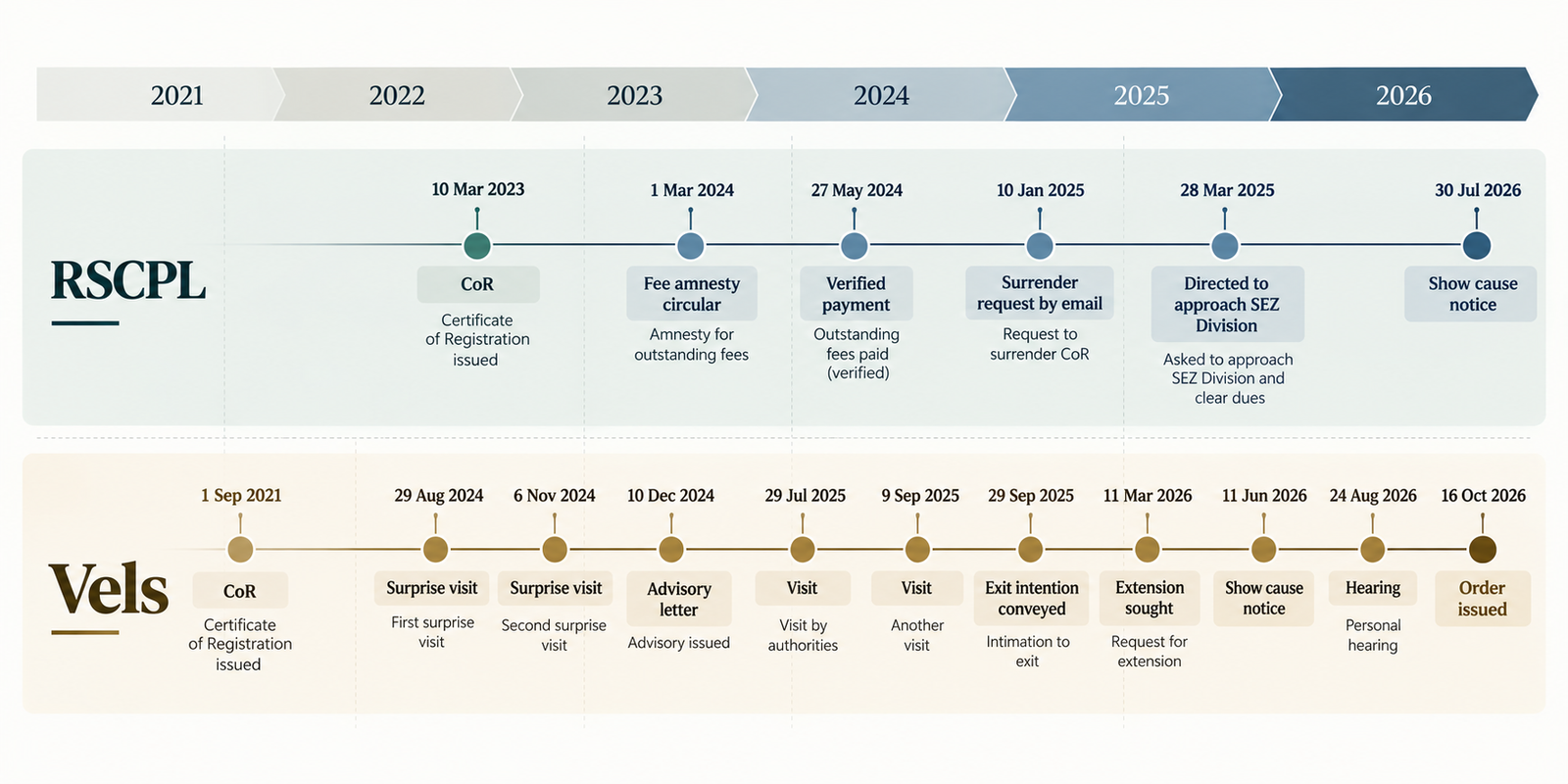
RSCPL (IFSC) Private Limited: A Surrender Request That Never Took Effect
What the show cause notice records
IFSCA registered RSCPL as a Finance Company for operating leases of ships on March 10, 2023. The notice traces the problem back to the fee regime that applied in its first full year.
IFSCA’s circular of March 1, 2024 gave regulated entities a one-time concession. No late fee would be levied for defaults between May 17, 2023 and March 31, 2024, provided all overdue fees and returns were cleared by March 31, 2024. IFSCA wrote to RSCPL on March 7, 2024 drawing its attention to that circular.
RSCPL says it paid twice: on March 25, 2024 and on May 27, 2024. IFSCA’s banker confirmed the May payment of USD 5,000. It could not trace the March payment.
On January 10, 2025, RSCPL emailed IFSCA applying to surrender its registration. IFSCA replied asking for:
- the late fee and interest on the FY 2023-24 fee;
- the FY 2024-25 fee, with late fee and interest.
RSCPL responded that its annual fee should start twelve months after its licence. In the same email, it said it was “accepting our failure” and asked to be allowed to exit without interest or penalty.
By July 2026, the notice alleges that the company owed:
- the late fee and interest on the FY 2023-24 fee;
- the annual fees for FY 2024-25, 2025-26 and 2026-27, with late fees and interest.
The annual fee follows the financial year, not the licence anniversary
RSCPL’s main argument was that “the annual fees is always applicable after 12 months”. IFSCA’s fee circulars do not work that way. The recurring fee belongs to the financial year and falls due early in that year, whatever the date of registration. The notice sets out the three circulars that applied over the period:
| Fee circular | Due date for the recurring fee | Consequence of delay |
|---|---|---|
| Circular F. No. 865/IFSCA/Banking/Fee Revision/2022-23 dated May 17, 2023 | Within 30 days of the end of the preceding financial year (clause 6(iii)(c) read with Schedule I) | Late payment fee under Schedule II (clause 10(i)) |
| Circular No. IFSCA-DTFA/1/2025 dated April 8, 2025 | By April 30 of the financial year to which the fee relates (clause 4(iii) read with Schedule I) | Simple interest of 0.75% per month (clause 8(i)) |
| Circular No. IFSCA-DTFA/1/2026 dated March 2, 2026 | By April 30 of the financial year to which the fee relates (clause 4.3 read with Schedule I) | Simple interest of 0.75% for every month or part thereof (clause 8) |
The USD 5,000 annual fee for a ship operating lessor stayed the same throughout. What changed was the consequence of paying late, and the operative circular has to be identified separately for each year.
FSCA issued Circular No. IFSCA-DTFA/1/2026 on March 2, 2026, prescribing the fee structure for entities undertaking permissible activities in IFSC. The circular applies from FY 2026-27 onwards. The circular’s own illustration confirms that the flat recurring fee for FY 2026-27 became due on April 1, 2026 and was payable by April 30, 2026. A corrigendum issued on March 13, 2026 (Circular No. IFSCA-DTFA/2/2026) confirmed that the March 2026 circular applies from FY 2026-27, and that earlier fee circulars, including IFSCA-DTFA/1/2025 dated April 8, 2025, stand superseded from its commencement. Source: IFSCA circulars dated March 2, 2026 and March 13, 2026.
When a payment cannot be traced, it has not been made
The disputed March 2024 payment raises a practical lesson that applies well beyond this case. RSCPL produced a SWIFT MT103 generated by its payment solution provider, which was a client-facing proof of transfer. IFSCA’s banker, ICICI Bank, said that to search for the transaction it needed the interbank SWIFT MT103 message. After re-examining all credits of around USD 5,000 received in March and April 2024, it found only the May 27, 2024 payment.
IFSCA then took a clear position on who carries the burden. Because the remittance began at RSCPL’s end, raising a tracer was the job of the remitting bank or payment operator, not IFSCA’s banker. IFSCA proposed a joint call between the company, its remitting channel and ICICI Bank. According to the notice, RSCPL did not respond.
The notice also points to how the one verified payment was applied. It treats the FY 2023-24 fee as paid late and the FY 2024-25 fee as unpaid, which indicates that the May 2024 remittance was applied to the earlier year. An entity that pays without specifying the financial year and fee head leaves that allocation to the regulator.
The RSCPL matter suggests a simple discipline, which is a recommended practice rather than a codified rule. Remit IFSCA fees through a regulated bank and retain the interbank SWIFT MT103 or the transaction’s unique end-to-end reference (UETR). State the financial year and fee head in the remittance details. Then ask IFSCA to confirm receipt and how the payment was applied. A confirmation screen or receipt from a payment platform shows that an instruction was given; it does not show that the money reached the regulator’s account.
Why the registration, and the fees, continued
RSCPL appears to have treated its January 2025 email as the end of its time in GIFT IFSC. The notice treats it differently: because outstanding dues stopped the surrender from being processed, “the Certificate of Registration continues”. Fees therefore kept falling due on April 30, 2025 and April 30, 2026.
Assumptions: the facts are as alleged in the show cause notice, and the figures cover principal annual fees only.
When RSCPL applied to surrender in January 2025, IFSCA’s demand covered two items: the late fee and interest on the FY 2023-24 fee, and the FY 2024-25 fee (USD 5,000) with late fee and interest.
By the date of the notice in July 2026, the alleged principal had grown to three annual fees: FY 2024-25, FY 2025-26 and FY 2026-27, which is USD 15,000. Each carries its own late fee or interest under the circular that applied to that year. The FY 2023-24 late fee and interest are on top of this.
If the registration still subsists on April 1, 2027, the FY 2027-28 fee will also fall due. This is an inference from the notice’s reasoning that fees accrue while the CoR continues. It is not a finding.
The original disagreement was about a single fee and its timing. The cost of not resolving it grows every financial year.
The SEZ side of the exit
IFSCA’s email of March 28, 2025 identified a second track that is often overlooked. An IFSC unit sits within an SEZ. IFSCA told RSCPL that the Office of the Administrator (IFSCA), SEZ Division, is the nodal office for issuing an exit order from GIFT IFSC/SEZ, and that the company should approach that office. The same email asked the company to clear its outstanding fees.
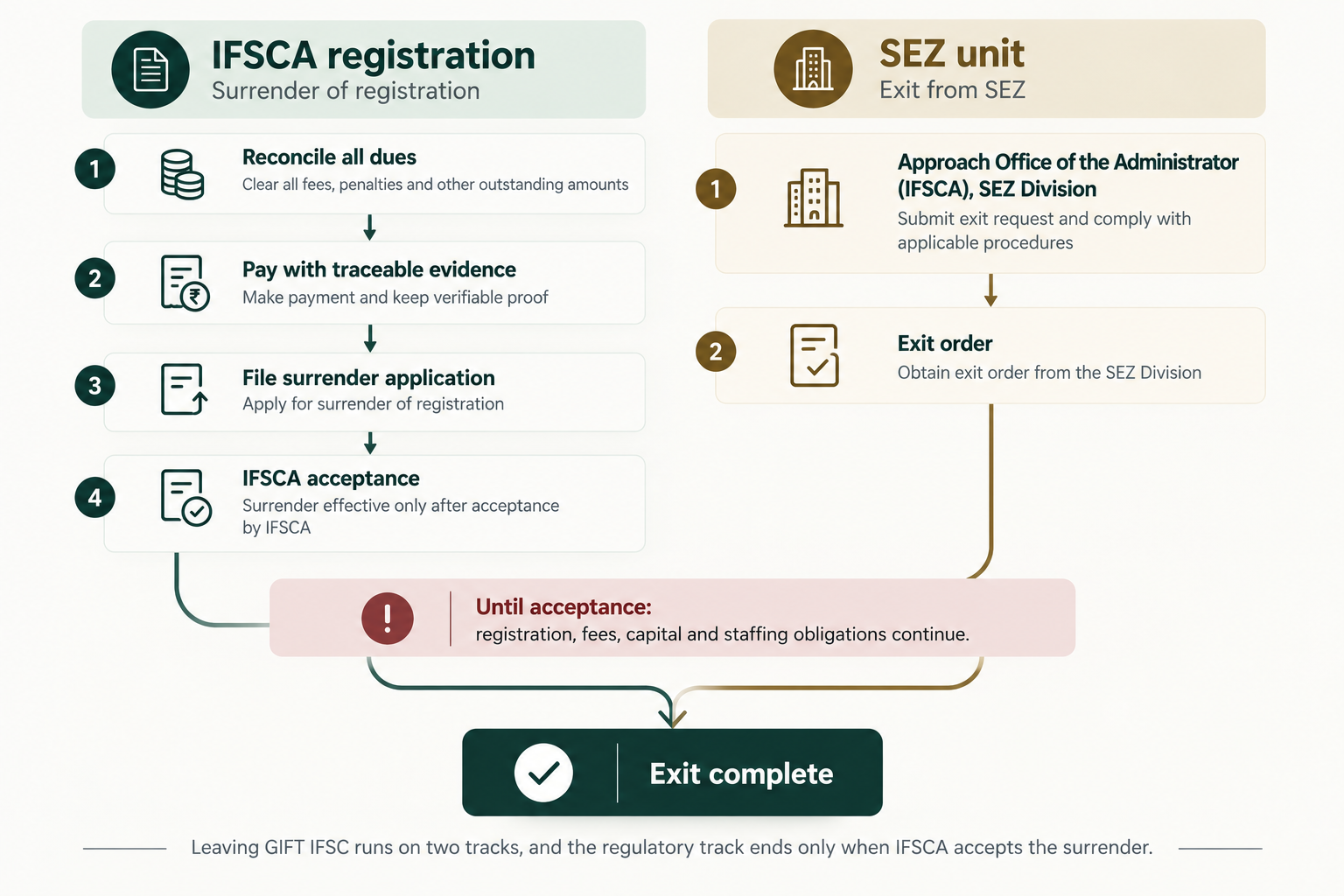
Leaving GIFT IFSC therefore involves two separate processes: the regulatory surrender of the registration, and the SEZ exit of the unit. In this case, both depended on clearing the same dues.
How a fee dispute becomes a Regulation 11 matter
The notice does not treat the unpaid fees simply as a debt. It frames them as breaches of:
- Regulation 3(7) of the IFSCA (Finance Company) Regulations, 2021, read with paras 3(f) and 3(g) of the conditions letter dated March 10, 2023. Para 3(f) requires the annual fee to be paid on time; para 3(g) requires ongoing compliance with the FC Regulations and the framework.
- Regulations 5(3A) and 10 of the FC Regulations, read with Clause G of the Ship Leasing Framework.
Once a fee default is a breach of a registration condition, Regulation 11 applies.
“11. Action in Case of Default — If a Finance Company or a Finance Unit, as the case may be, fails to fulfil any of the conditions subject to which the registration under Regulation 3 has been granted, the Authority may take any action as it may deem fit, including suspension, withdrawal or cancellation of registration, after giving an opportunity to the entity, of making its submissions.”
The trigger for action is a failure to meet any condition of registration, and paying the annual fee on time is one of those conditions. The range of action is wide, from directions and warnings up to cancellation. The only procedural safeguard written into the regulation is that the entity must first be given a chance to make submissions. That is why both matters began with a show cause notice. Clause P of the ship and aircraft leasing frameworks contains an equivalent power.
Vels Aviation Services IFSC Private Limited: An Exit Discussed but Never Filed
Four surprise visits and an empty office
IFSCA registered Vels Aviation as an aircraft operating lessor on September 1, 2021. Supervisory staff made surprise visits to its GIFT IFSC office on four dates:
- August 29, 2024 and November 6, 2024: the office was closed and no key managerial personnel were present.
- July 29, 2025: no personnel were present, the CoR was not displayed, and dues were pending.
- September 9, 2025: no personnel were present.
IFSCA issued advisory letters on December 10, 2024 and August 1, 2025, and met the company on September 22, 2025. Vels then displayed its CoR and cleared the pending dues. On staffing, however, it said it was in “final discussion on the exit route” because it was unable to run operations in the SEZ.
Despite that statement, it neither deployed staff nor applied for surrender. After a further meeting in March 2026, it asked for time until May 15, 2026, saying it would either complete an aircraft sale and begin closure, or hire staff at GIFT City. It did neither by that date, and it did not pay the FY 2026-27 annual fee.
Clause O(ii) of the Aircraft Lease Framework, and para 4(c) of the conditions letter, require the lessor to deploy resources commensurate with its business operations. The QJAE found this requirement breached. The company had placed an office administrator at GIFT City from August 2026, but only after the show cause notice.
A negative owned fund
Clause F(i) of the Aircraft Lease Framework requires a lessor to maintain a minimum owned fund of USD 200,000 at all times. Vels Aviation’s audited balance sheet for FY 2024-25 showed accumulated losses that exceeded its entire share capital.
Figures are from the audited FY 2024-25 balance sheet, as quoted in the order.
Share capital: USD 3,068,660
Reserves and surplus: (–) USD 3,495,550
Owned fund: 3,068,660 – 3,495,550 = (–) USD 426,890
Required minimum owned fund: USD 200,000
Capital needed to restore compliance: 200,000 – (–426,890) = USD 626,890
This is the gap measured at March 31, 2025. Any losses incurred after that date would increase the amount needed. The calculation also assumes that no other items affect owned fund under the framework’s definition, such as intangible assets or deferred revenue expenditure, which must be deducted. The order directed the company to meet the requirement within 45 days of receiving the order.
The company did not dispute the figures. It explained that the leased aircraft was due for a major maintenance event, which the order describes as a 16C inspection estimated at USD 2 million. It said the costs of acquiring and running the aircraft had wiped out its capital and reserves. It also said the aircraft would be worth USD 5 to 5.5 million once restored, and that it was trying to raise funds.
The QJAE held that these reasons were irrelevant to the breach.
“…the Noticee is required to maintain minimum owned fund of USD 200,000 at all times and the same is the perpetual requirement to carry out the business of aircraft leasing.”
Any single-asset lessor should take note. When one aircraft accounts for the whole business, one heavy maintenance event can halt revenue and erode capital at the same moment. The minimum owned fund is a continuing condition of registration, not a figure checked only at entry. Planning for a large maintenance cost, either by building reserves or arranging committed shareholder support, is a commercial decision. The regulator, however, will judge the consequences against a fixed standard.
Hardship does not suspend the annual fee
Vels Aviation said it could not pay the FY 2026-27 fee, due by April 30, 2026, because the maintenance event had stopped its revenue. The QJAE described the annual fee as a regulatory obligation and did not accept that explanation.
This is consistent with IFSCA’s earlier warning in para 7 of the March 1, 2024 circular. From FY 2024-25, fee waivers would be considered only where the entity could prove the non-payment was due to reasons beyond its control.
IFSCA’s March 1, 2024 circular states that, from FY 2024-25, requests for waiver of fees, including late fees, will not be entertained unless the entity proves that the default arose from reasons beyond its control. It also says that requests for relaxation citing lack of clarity or knowledge of a requirement will not be entertained. In Vels Aviation, a commercial setback, an unplanned maintenance cost, did not excuse non-payment. Entities should not assume that business difficulty will be treated as a reason beyond their control.
What the Quasi-Judicial Authority for Enforcement decided
The QJAE asked three questions: whether the violations were established, whether they warranted action, and, if so, what action. It gave a separate response to each violation:
| Violation | Finding | Direction |
|---|---|---|
| No resources deployed (Regs 5(3A) and 10(1); Clause O(ii); CoR conditions 4(a) and 4(c)) | Remedied, but only after a long period of non-compliance | Warning not to repeat |
| Owned fund below USD 200,000 (Regs 3(5)(i), 5(3A), 10(1) and Schedule; Clause F(i); CoR condition 4(a)) | Non-compliant for almost two years; no corrective action | Comply within 45 days of receipt of the order |
| FY 2026-27 annual fee unpaid (Regs 5(3A) and 10; Clause G; Fees Circular; CoR condition 4(a)) | Unpaid for more than four months after the due date | Pay with applicable interest within 45 days |
It also restrained the company from seeking any new business until it complied with the owned fund and fee directions.
The outcome is measured. IFSCA did not cancel the registration, even though Regulation 11 allowed it to. It gave the company a defined period to put things right and made new business conditional on doing so. The restraint has a commercial cost of its own: a lessor that cannot seek new business cannot re-lease its aircraft after restoration until both directions are met.
Assumptions: the USD 5,000 annual fee for FY 2026-27 was due by April 30, 2026. It is paid 7 months and 10 days after that date. Interest is simple interest of 0.75% for every month or part thereof, per clause 8 of Circular IFSCA-DTFA/1/2026 as described in IFSCA’s documents.
Months counted: 7 full months, plus a part month treated as a full month = 8 months
Interest: 5,000 × 0.75% × 8 = USD 300
Total payable: 5,000 + 300 = USD 5,300
The interest is modest. The real cost of the default lies elsewhere: the breach of a registration condition, enforcement proceedings, a published order, and, in Vels Aviation’s case, a restraint on new business. Confirm the exact method of counting months against the circular before relying on this calculation.
What These Matters Establish About Leaving GIFT IFSC
A certificate of registration does not lapse through inactivity
Both companies had commercially stopped functioning as IFSC lessors well before IFSCA acted. Legally, nothing had changed. RSCPL had asked to surrender, but the request was never processed. Vels had only talked about leaving. The registration therefore remained in force in both cases, and with it the duties to pay fees, maintain capital and keep a functioning office.
An entity winding down its business remains a regulated entity until the regulator accepts its exit.
“At all times” obligations do not pause for a business downturn
The owned fund requirement in Clause F(i), and the resource requirement in Clause O(ii) of the Aircraft Lease Framework, are continuing conditions. The QJAE’s description of the owned fund as a “perpetual requirement” reflects that. Because an entity cannot be partly registered, a dormant entity faces the same standards as an active one. The practical answer is to plan the exit before the business reaches the point where it can no longer meet those standards.
Correspondence becomes part of the record
Both documents quote the companies’ own emails at length. RSCPL’s admission and its request for a “graceful” exit, and Vels Aviation’s statements about exit discussions and the deadlines it later missed, were all relied on as evidence. Informal messages to a regulator are formal communications for this purpose. Undertakings that are not met tend to be held against the entity that gave them.
The Same Principles Under the IFSCA (Fund Management) Regulations, 2025
Both matters arose under the Finance Company Regulations. For an FMONLINE reader, the natural question is whether a Fund Management Entity faces the same position. On the provisions themselves, the answer is largely yes.
Surrender works the same way. Regulation 15 of the IFSCA (Fund Management) Regulations, 2025 keeps an FME’s registration valid unless it is suspended, cancelled, or surrendered by the FME and taken on record by the Authority. Regulation 16 permits surrender, but makes clear that it takes effect only on IFSCA’s acceptance.
“16. A FME may file an application with the Authority for surrender of its certificate of registration. Explanation.- The voluntary surrender of certificate of registration shall be effective only after its acceptance by the Authority.”
Filing a surrender application does not by itself end an FME’s registration. Until IFSCA accepts the surrender, the FME remains registered and its obligations continue, including net worth, KMP presence, reporting and recurring fees. The RSCPL notice shows how a pending surrender is treated in practice: the CoR “continues” and fees keep falling due.
The continuing conditions have direct FME equivalents:
- Presence in IFSC. Regulation 7(5) requires the principal officer and the other KMPs specified in Regulation 7 to be based in IFSC. IFSCA has already acted on this for FMEs: it issued a warning order to Neo Asset Management Private Limited (IFSC Branch) for the absence of its principal officer and KMPs during surprise visits.
- Capital. Regulation 8(1) requires an FME to meet its net worth requirement at all times. The Second Schedule sets the minimum at USD 75,000 for an Authorised FME, USD 500,000 for a Registered FME (Non-Retail) and USD 1,000,000 for a Registered FME (Retail).
- Enforcement. Regulation 143 allows IFSCA to take action, including suspension or cancellation, if an FME fails to comply with any condition of registration or contravenes the Act, regulations or circulars.
The same pattern follows. An FME whose sponsor has lost interest, whose principal officer has moved on, or whose losses have eroded its net worth is exposed in exactly the way Vels Aviation was.
Planning an Orderly Exit From GIFT IFSC
The steps below are recommended practice drawn from the two matters, not a sequence prescribed by regulation. The applicable regulations, and any procedure IFSCA specifies, will govern a particular exit.
- Decide to exit while the entity is still compliant. It is far easier to surrender while net worth, staffing and fees are in order than to negotiate an exit while enforcement proceedings are under way.
- Reconcile every IFSCA due since registration. Identify the applicable fee circular for each financial year, compute late fees or interest under that circular, and ask IFSCA to confirm the outstanding position in writing.
- Pay through a traceable channel. Retain the interbank MT103 or UETR and map each remittance to a fee head and financial year.
- File the surrender application in the form and through the channel IFSCA specifies, and obtain an acknowledgement.
- Stay compliant until acceptance. Keep the minimum capital, staffing, filings and any fee that falls due while the application is pending. A surrender pending on April 1 can bring a new year’s fee into play.
- Run the SEZ exit in parallel with the Office of the Administrator (IFSCA), SEZ Division, which issues the exit order for the unit.
- Close the remaining legal and tax matters for the company, LLP or branch under the laws that apply to it once the regulatory and SEZ exits are complete.
How IFSCA Enforcement Proceedings Run
The two documents also show the procedure that applies once a matter reaches enforcement. Under IFSCA’s Delegation of Powers order dated November 11, 2025:
- Issue of the notice. The Chief General Manager of the Enforcement Division issues show cause notices.
- The adjudicating committee. After the notice, the Chairperson constitutes a committee of three officers of the rank of Executive Director or CGM. One comes from the Enforcement Division, one from the sector concerned (excluding the division that referred the case), and one from another sector. The committee either decides the matter as the Quasi-Judicial Authority for Enforcement, or recommends action to a higher authority as the Advisory Committee for Enforcement.
- Hearing and order. The committee must give a personal hearing and pass a speaking order.
- Who can cancel. A registration cannot be cancelled by an authority lower in rank than the officer who granted it.
The same order also states that enforcement proceedings may not cover cases where an entity seeks voluntary surrender. The interpretive point that follows is this: an entity that surrenders cleanly stays on the voluntary track, while one that leaves dues or breaches behind risks being moved onto the enforcement track.
The RSCPL notice allows six weeks for a reply. If no reply is filed, IFSCA may proceed ex parte on the material on record. The entity may also ask for a personal hearing. Vels Aviation used both opportunities, appearing through its General Manager and Company Secretary. Even so, it could not contest the facts in the regulator’s record, including its own audited figures.
Planning the Exit at the Point of Entry
GIFT IFSC entities rarely run into trouble because they set out to break the rules. More often they arrive with a business plan and no plan for what happens if that business slows, stalls or ends. RSCPL’s single fee dispute and Vels Aviation’s single aircraft each turned into a regulatory problem because the registration was left running after the business had stopped.
For a Fund Management Entity, the lesson is to treat the exit as part of the original structuring. Sponsors and boards should agree at the outset who will fund the net worth if losses erode it, who will remain as principal officer during a wind-down, and when the FME will surrender rather than drift. These decisions are easier to make while the entity is compliant than after a surprise visit or a show cause notice. GIFT IFSC remains open to entities that want to leave. The two matters show that IFSCA expects an exit to be completed formally and in full, and that obligations continue until it is.
The full text of both IFSCA documents discussed in this article is available here: Show Cause Notice in the matter of RSCPL (IFSC) Private Limited dated July 30, 2026 and the Order in the matter of Vels Aviation Services IFSC Private Limited dated October 16, 2026 The RSCPL document is a show cause notice and sets out IFSCA’s allegations only, while the Vels Aviation document is a final order containing the findings and directions of the Quasi-Judicial Authority for Enforcement.
Frequently Asked Questions
Does applying to surrender an IFSCA registration stop the annual fee?
Not by itself. A surrender takes effect only when IFSCA accepts it. Regulation 16 of the FME Regulations, 2025 says this expressly. In the RSCPL matter, the surrender request could not be processed because dues were outstanding, so IFSCA treated the CoR as continuing and alleged that fees for FY 2025-26 and FY 2026-27 had also become payable.
Is the IFSCA annual fee counted from the date of registration?
No. Under the fee circulars cited in both matters, the recurring fee relates to a financial year. Under Circular IFSCA-DTFA/1/2026, the flat recurring fee is payable by April 30 of the year to which it relates. RSCPL’s argument that the fee should begin twelve months after licensing is not reflected in those circulars.
Can financial difficulty justify missing the annual fee or the minimum owned fund?
On the reasoning in Vels Aviation, no. The QJAE treated the owned fund as a continuing requirement and the annual fee as a regulatory obligation, and it rejected explanations based on maintenance costs and lost revenue. IFSCA’s March 1, 2024 circular allows a waiver to be considered only where the entity proves the default was beyond its control.
What happens if an entity does not reply to an IFSCA show cause notice?
The RSCPL notice states that if no reply arrives within six weeks, IFSCA will treat the entity as having nothing to say and may proceed ex parte on the material on record. The entity may also ask for a personal hearing. Under IFSCA’s Delegation of Powers order, the Quasi-Judicial Authority for Enforcement must give a hearing and pass a reasoned order.
Do these orders apply to Fund Management Entities?
Both matters were decided under the Finance Company Regulations, so they do not bind FMEs directly. The underlying requirements, however, have close FME equivalents: surrender only on acceptance (Regulations 15 and 16); principal officer and KMPs based in IFSC (Regulation 7(5)); net worth at all times (Regulation 8 and the Second Schedule); IFSCA’s power to act on breaches of registration conditions (Regulation 143). IFSCA has also issued a warning to an FME for the absence of its principal officer and KMPs during surprise visits.
Is a payment platform’s transfer confirmation enough proof of a fee payment?
It may not be. In the RSCPL matter, IFSCA’s banker needed the interbank SWIFT MT103 to trace the transaction and did not accept the client-facing confirmation as proof. IFSCA also placed the responsibility for raising a tracer on the remitting side.
By CS Prashant Kumar, Founder, FUNDREG